
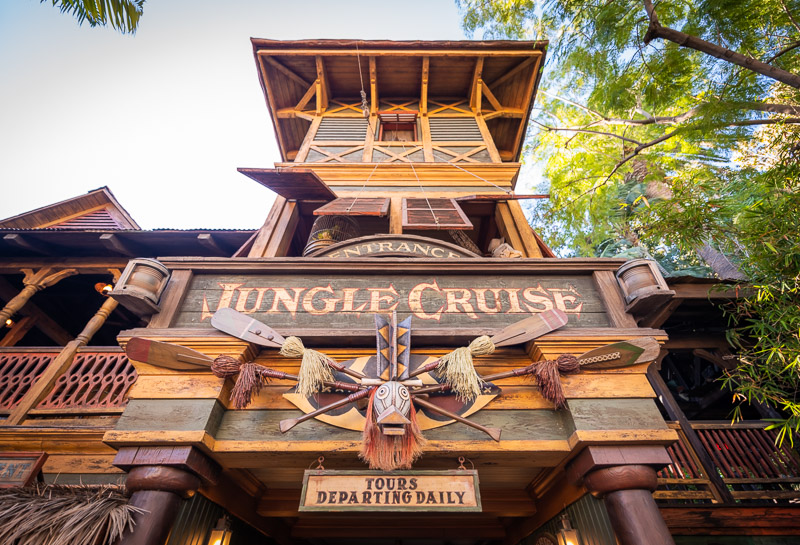
Walt Disney Imagineering shared a behind-the-scenes video of a team installing a first-ever large-scale 3D printed prop to the Jungle Cruise attraction. This post shares video of this milestone, how WDI partnered with an emerging tech company to make this project a reality, and how this could be utilized in future attractions.
Let’s start with what Imagineering just accomplished–the addition of an outrigger canoe on the Jungle Cruise at Disneyland. Imagineering embarked on this project as a test to see whether 3D printed props offered advantages over their traditional process; this marks the first time that a large-scale 3D prop has been permanently added to an attraction.
TheJungle Cruise boat is made with a new format Imagineering is experimenting with called large-format additive manufacturing. That’s basically a fancy term of art for 3D printing on a grander scale, presumably to make it sound more sophisticated than what your Uncle Buck is doing at home with his model train village or whatever.
The key throughout that seems to make this process unique is the focus on large-scale 3D prints. It sounds as if Imagineering has experimented previously with 3D printing, perhaps even in-house, but now they’re doing everything on a bigger and more permanent scale.
The new boat was designed by Walt Disney Imagineering’s Research & Development arm, and then sent to its vendor Haddy to print the boat. Imagineers shared that they went to a series of conferences and conventions to network (like IAAPA), and find the right company for a project of this nature.
Imagineering stumbled upon Haddy, and found that the vendor would be able to manufacture huge props suitable for the parks. There’s a lot more to WDI’s partnership with Haddy that has us excited, but let’s first focus on this boat itself.

Imagineers said that they took the old boat and did a 3D scan of it in order to get the accurate dimensions. For the creative side, they took a photo taken in the 1960s and then finished the boat with details once the printing process was completed. The end result is a boat that’s indistinguishable from one manufactured using a traditional process, and much more efficient to produce–and repeat, if necessary.
Large-scale fabrication using Haddy’s 3D printing is just one way Imagineers are innovating for future Disney Parks projects. Here’s the video that WDI posted on LinkedIn of the installation and creation of the boat:
NEW: Disney Parks history has been made! A 3D-printed canoe has been installed on Jungle Cruise at Disneyland Park.
The canoe marks a major milestone: the first-ever 3D-printed prop to be permanently installed on a Disney Parks attraction.
Large-scale fabrication using Haddy’s… https://t.co/f8LP5BJPnz pic.twitter.com/3hYrY8ojmT
— Drew Smith (@DrewDisneyDude) January 7, 2026
Haddy, a 3D-printing business based in Florida that’s located about 2 hours from Walt Disney World, combines AI-driven robotics with advanced 3D printing to deliver design freedom, rapid production, and sustainable materials. The company touts the ability to go from vision to finished product in “days, not months.”
Haddy leverages robotic arm additive manufacturing systems to produce furniture and more. Last year, the startup opened the world’s largest 3D printing factory, based on total throughput and machine count, with Haddy’s 32,000 square-foot St. Petersburg, Florida site.

Haddy was launched in 2022 by CEO Jay Rogers, a U.S. Marine Corps veteran who also founded the defunct manufacturing company Local Motors, which created innovative 3D vehicles. As of last year, the startup employed a dozen people. The company uses eight robots to print furniture and other products using materials repurposed from old fishing nets and polymer plastics in granular form.
Haddy plans to open microfactories all over the world, with the aim of moving production closer to target markets to increase efficiency and reduce supply chain disruptions. It sounds like a really impressive startup with a smart vision, and I hope it’s a success.

It would seem that the Walt Disney Company agrees, and wants to help ensure Haddy’s continued growth. Haddy was selected as one of four startups for the 2025 Disney Accelerator program to gain financing, platforming and mentoring.
Disney Accelerator selects a handful of startups each year that align with the company’s goals in entertainment, theme parks & hospitality, and allows those companies to “…gain access to the range of creative expertise and resources of The Walt Disney Company to help them develop new entertainment experiences and products.”
Since 2014, more than 60 global companies have come through Disney Accelerator, including familiar names such as Epic Games, Eleven Labs, Kahoot!, Attentive, StatusPro, AudioShake, and many more. The program culminates with the Disney Accelerator Demo Day, which was held back in November on The Walt Disney Studios lot in Burbank, California. That’s where the companies first revealed their plans to install the large-scale boat prop in the Jungle Cruise.

Haddy CEO Jay Rogers said that 3D printing and Disney is a “match made in heaven,” but also one developed over the course of 40 years. That’s because 3D printing was only about prototypes for most of its existence.
Haddy has revolutionized 3D printing by moving out of that and into a functional role in the theme parks and beyond. Rogers says that Haddy’s process creates items that are reliable, less expensive, faster to develop, and replicable in any park, all over the world.
In an interview with CNET, Rogers added that a 20-foot boat made by a traditional boat-maker can take 1,000 human hours, but not so for the 3D-printed Jungle Cruise canoe prop. The traditional process unfolds over weeks to months, with the mold-making process being repeated an average of over 30 times being the time-consuming portion of the manufacturing.

Rogers said that it took Haddy only 70 robot hours to manufacture. Both processes use a digital file as a starting point, but the difference is that Haddy can make tweaks to the file and reprint the boat if there are any problems with the final product. No more mold-making necessary.
“It’s not just faster to make, it’s faster to develop,” said Rogers. This is in addition to being able to recycle any 3D-printed material for new objects. Once a prop reaches the end of its life, it can be melted down and 3D-printed again into something new.

It sounds like the Jungle Cruise boat is simply proof-of-concept. A large-scale prop in an outdoor environment to see how it holds up before embarking on more ambitious projects. And there are plenty of those in the pipeline.
In another interview, Imagineer Michael Hundgen, Portfolio Executive Creative Producer for Walt Disney World, talked about the possibilities: “It’s the perfect recipe for success, for how we can take something that’s very labor-intensive, and put it into a process that not only gains efficiencies of speed and cost, but also lets designers iterate and play in a way we didn’t have before.”
Hundgen added that what’s great about Haddy is that there are so many use cases across Imagineering’s upcoming projects. It could be a closet door from Monstropolis, it could be an entertainment platform, or it could even be rockwork for the parks. It could even be a piece of furniture for hotel rooms.

Of these examples, the most exciting and obvious strikes me as the Monsters, Inc. Doors Coaster coming to Monstropolis. That seems tailor-made for this type of 3D printing, since it’s indoors and a high-speed roller coaster. Although not mentioned, I can’t help but wonder whether this process might be used to add new props to the ride-through portion of Rock ‘n’ Roller Coaster Starring the Muppets, too.
I don’t purport to be an expert on 3D printing versus traditional manufacturing, but even if there are noticeable quality differences or hallmarks of a 3D print to the astute eye, those presumably won’t be visible when you’re flying by at a fast speed.
For what it’s worth, 3D printing manufacturers and experts claim there’s no discernible difference (but of course they would). They contend that the process is all upside versus traditional manufacturing. Even with no background knowledge, I’m skeptical of that claim–but it doesn’t really matter in many of Imagineering’s most obvious use cases where it might be fine to make some sacrifices in the name of lower costs, increased efficiency, and replicability.

Then again, I’ve always thought that the amount of money Disney spent on Expedition Everest’s Yeti Audio Animatronics figure–in a park that needed multiple new attractions even at the time–was wasteful. That the money should’ve been better allocated to other attractions, with more efficient (read: cheaper) props being used in a high-speed roller coaster.
Given how many Walt Disney World fans think fixing the Yeti should be a top priority despite Animal Kingdom needing another half-dozen new rides, I’m clearly in the minority. That, or fans don’t realize that budgets are finite, and one thing happens at the expense of something else.
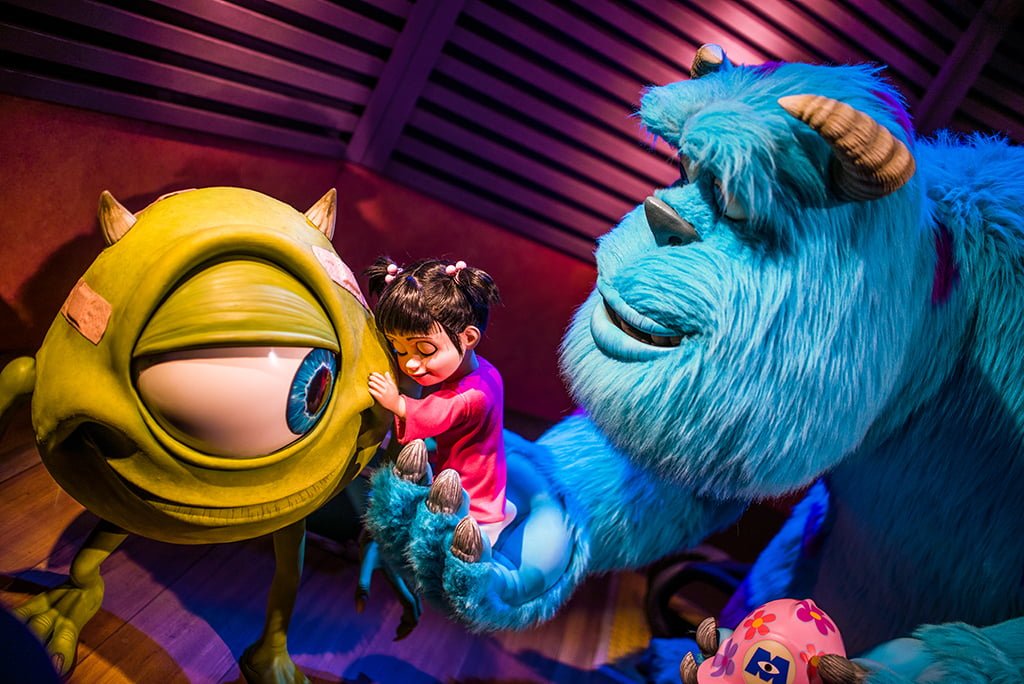
Suffice to say, I do not want Imagineering to spend $40 million on a state of the art Sulley Audio Animatronics figure that paws at guests on a coaster going 50 MPH or whatever. I’m all for efficiencies where they make sense and can help stretch budgets further.
It makes sense to flesh out the factory floor that the coaster zips through in the Monsters, Inc. Door Coaster with cheaper props. Put the budget towards Audio Animatronics in the pre-show, opening or closing acts, or any slower show scenes there might be. Those should absolutely be on par with the ones in Monsters, Inc. Ride & Go Seek at Tokyo Disneyland. Otherwise, utilize 3D printing along with limited-motion figures and props recycled from the ride that’s closing at DCA. Let SuperStar Limo ride on again!
Planning a Walt Disney World trip? Learn about hotels on our Walt Disney World Hotels Reviews page. For where to eat, read our Walt Disney World Restaurant Reviews. To save money on tickets or determine which type to buy, read our Tips for Saving Money on Walt Disney World Tickets post. Our What to Pack for Disney Trips post takes a unique look at clever items to take. For what to do and when to do it, our Walt Disney World Ride Guides will help. For comprehensive advice, the best place to start is our Walt Disney World Trip Planning Guide for everything you need to know!
YOUR THOUGHTS
What do you think about Imagineering testing out large-scale 3D printing for attraction props? Think this is a good way to leverage efficiencies where possible, or will this diminish the quality and caliber of the Disney attraction experience? Agree or disagree with us that this would be perfect for the Monsters, Inc. Doors Coaster? Any questions we can help you answer? Hearing your feedback is both interesting to us and helpful to other readers, so please share your thoughts below in the comments!